
Author

admin

Browsing

In comments to Fox News Digital, the State Department’s position on Sudan’s warring parties has hardened, as a 500-day siege of the Darfur city of El Fasher has trapped hundreds of thousands of civilians. 

Sudan suffers from the world’s largest displacement: Between 13 million and 15 million people have been ripped from their homes, and an estimated 150,000 people have been killed since the rebel Rapid Support Forces (RSF) and the Sudanese government’s Sudanese Armed Forces (SAF) started fighting in April 2023. The civil war’s roots lie in tensions following the 2019 ousting of President Omar al-Bashir.

‘The RSF, during the siege of El Fasher and surrounding areas, committed myriad crimes against humanity, including murder, torture, enslavement, rape, sexual slavery, sexual violence, forced displacement and persecution on ethnic, gender and political grounds,’ an Independent International Fact-Finding Mission for Sudan reported to the U.N.’s Human Rights Council last Friday. 

The report agreed with other accounts that the RSF is trying to starve El Fasher’s residents to death, stating, ‘The RSF and its allies used starvation as a method of warfare.’

Aid is being blocked from going into El Fasher, the U.N. Secretary-General’s spokesperson, Stéphane Dujarric, stated Aug. 29  ‘Supplies are pre-positioned nearby but efforts by the United Nations and its partners to move them into El Fasher continue to be hampered.

‘The situation in El Fasher remains dire,’ Mariam Wahba, research analyst at the Foundation for Defense of Democracies, told Fox News Digital.  ‘The RSF has effectively encircled the city, cutting off key supply routes and subjecting civilians to indiscriminate shelling. Satellite images indicate a wall is being built to trap civilians inside, consistent with RSF tactics used elsewhere. These ‘kill zones’ leave residents with no means of escape. El-Fasher is the last major SAF-held city in Darfur. If it falls, the RSF would control nearly all of Darfur, consolidating both territory and economic assets, particularly lucrative gold mines.’

President Donald Trump’s Special Advisor for Africa, Massad Boulos, met Sudan’s army chief, Abdel Fattah al-Burhan in Switzerland last month. From the tone of the State Department’s responses to Fox News Digital’s questions on Sudan this week, there appears to be little progress on the path to peace. 

A spokesperson stated, ‘since the April 2023 outbreak of conflict in Sudan, we have witnessed significant backsliding in Sudan’s overall respect for fundamental freedoms, including religious freedom.

‘In order to safeguard U.S. interests, to include the protection of religious freedom in Sudan, U.S. efforts seek to limit negative Islamist influence in Sudan’s government and curtail Iran’s regional activities that have contributed to regional destabilization, conflict, and civilian suffering.’

Wahba is also concerned about the activities of foreign ‘bad actors’ in Sudan. ‘Iran has provided the SAF with drones and technical support. Emerging reports point to Iranian interest in helicopter facilities. Iran sees its involvement in Sudan as a gateway for extending its footprint in Africa.’

Wahba continued, ‘Russia has played both sides of the conflict. It has pursued a naval base on Sudan’s Red Sea coast, which would give Moscow direct access to critical shipping lanes, while also profiting from gold smuggling through RSF-linked networks.’

‘Regional powers are also advancing their own interests. Egypt has publicly backed the SAF, aligning with Sudan’s ruler, Abdel Fattah al-Burhan. Saudi Arabia is aligned with Egypt in backing al-Burhan. The United Arab Emirates, on the other hand, has provided significant support to the RSF, viewing its commander, Mohamed Hamdan Dagalo – widely known as Hemedti – as the custodian of Sudan’s gold exports and the path to its plans for port development along the Red Sea coast.’

Wahba concluded, ‘Burhan’s willingness to engage with Washington is a potential opening. This does not mean the U.S. should unconditionally back the SAF, but it could form the basis for a more defined U.S. strategy, one that makes U.S. engagement contingent on the SAF reining in, or removing, its Islamist militias and leadership.

This post appeared first on FOX NEWS

President Donald Trump just took a pivotal step to make healthcare affordable again.

On Sept. 4, his administration announced that most Americans will now be eligible to buy what are known as ‘copper plans’ on the ObamaCare exchanges. Before this reform, nearly all Americans were legally barred from buying these much more affordable plans. But now working families can get the plans they need at a price they can afford – and many uninsured people will likely get covered as a result.

The president is fixing one of the fundamental problems with ObamaCare. That law forced Americans who get their insurance on the individual market to buy costly plans, and in the 11 years since the law went into effect, they’ve gotten even pricier.  

ObamaCare plans have risen by nearly 200% since 2013. What’s more, prices for all plans are expected to rise another 18% by the start of next year.

ObamaCare’s authors knew their law would make healthcare more expensive. That’s why they quietly created an actually affordable option, which they called ‘copper plans.’ These plans cover pre-existing conditions, essential health benefits and everything else that ObamaCare requires, but they come with slightly higher out-of-pocket costs in exchange for dramatically lower premiums. 

Tens of millions of people could benefit from these options, but the federal government only allowed a minuscule number of Americans to buy them. Basically, you had to be under the age of 30. While anyone else could apply for a ‘hardship exemption’ to become eligible, the federal government rarely, if ever, granted these requests, forcing people to pay much more.

No longer. The Trump administration has effectively said that most Americans are now eligible for a hardship exemption, meaning anyone can buy a copper plan. Research from my organization shows that, on average, copper plans have 22% lower premiums than the typical bronze plan – and they cost up to 60% less than ObamaCare’s gold plans. By choosing these options, families can literally save hundreds or even thousands of dollars per year.

The return of affordability is reason enough to praise the president’s move. But this reform will have the added benefit of empowering uninsured people to finally get coverage they can afford. Nearly 27 million Americans are uninsured, many – if not most – because health insurance costs too much. They’ve needed access to copper plans, but their own government has blocked them. Now they’re free to buy better coverage.

Crucially, the uninsured population has the exact groups of people who can help the ObamaCare exchanges become more sustainable. The second and third-largest groups of the uninsured are between the ages of 26 and 34 and 35 and 44, respectively. These tend to be healthier people who don’t need costly plans because they don’t need much health care. As such, they don’t mind the higher out-of-pocket costs that come with the typical copper plan.

By helping to get more of these people covered, President Trump may very well stop the doom loop that has defined ObamaCare – a doom loop of ever-higher prices driving more and more people out of the markets altogether. And with fewer uninsured Americans and more people on private coverage, hospitals will see their uncompensated care costs drop. So hospitals – especially rural hospitals – will be on stronger footing.

This single reform could help millions – if not tens of millions – get more affordable coverage. It also meshes well with another commonsense policy issued by President Trump. He has reversed the Biden administration’s restrictions on short-term plans, empowering Americans to buy even more affordable coverage options for years at a time. 

This reform will also expand coverage to more uninsured people, while enabling others to get plans that better fit their budgets. We’re talking Americans of all ages who are in between jobs and looking for work, those who’ve retired but aren’t yet eligible for Medicare, and working families desperately looking for affordable coverage.

Americans urgently need this healthcare relief. While Democrats and the media are demanding that Republicans merely expand ObamaCare subsidies to prevent people from losing coverage, that’s not a real or sustainable solution. 

More government subsidies only make health insurance more expensive, not less. President Trump has taken the better road by giving Americans greater access to more affordable plans.

When it comes to helping families out, the president’s short-term reform will make a long-term difference, and his copper plans reform gets a gold star.

This post appeared first on FOX NEWS

Here are some charts that reflect our areas of focus this week at


XLU Leads with New High

Even though the Utilities SPDR (XLU) cannot keep pace with the Technology SPDR (XLK) and Communication Services SPDR (XLC), it is in a leading uptrend. XLU formed a cup-with-handle from November to July and broke to new highs the last two weeks. ETFs hitting new highs are in strong uptrends and should be on our radar.


Metal Mania in 2025

In a tribute to Ozzy, metals are leading the way higher in 2025. The PerfChart below shows year-to-date performance for the continuous futures for 12 commodities. Copper, Platinum and Palladium are up more than 45% year-to-date, while Gold is up 28.38% and Silver is up 35.30%. QQQ is up 10.52% year-to-date, but lagging these metals. The other commodities are mixed.


Multi-Year Highs for Silver and Copper

The next chart shows 11 year bar charts for five metals. Gold broke out in early 2024 and led the metals move with an advance the last 21 months. Silver and copper broke out to multi-year highs. Platinum broke above its 2021 high and Palladium got in the action with an 18 month high. There is a clear message here: metals are moving higher and leading as a group.  


Home Construction Hits Moment of Truth

The Home Construction ETF (ITB) hit its moment of truth as it rose to its falling 40-week SMA. Notice that ITB failed just below this moving average in August 2023. During the 2023-2024 uptrend, the 40-week SMA was more friendly as ITB reversed near this level in October 2023 and June 2024. ITB surged to the falling 40-week SMA in July, but the long-term trend is down and this area could be its nemesis.

Thanks for Tuning in!

See TrendInvestorPro.com for more


The S&P 500 ($SPX) just logged its fifth straight trading box breakout, which means that, of the five trading ranges the index has experienced since the April lows, all have been resolved to the upside.

How much longer can this last? That’s been the biggest question since the massive April 9 rally. Instead of assuming the market is due to roll over, it’s been more productive to track price action and watch for potential changes along the way. So far, drawdowns have been minimal, and breakouts keep occurring. Nothing in the price action hints at a lasting change — yet.

While some are calling this rally “historic,” we have a recent precedent. Recall that from late 2023 through early 2024, the index had a strong start and gave way to a consistent, steady trend.

From late October 2023 through March 2024, the S&P 500 logged seven consecutive trading box breakouts. That streak finally paused with a pullback from late March to early April, which, as we now know, was only a temporary hiccup. Once the bid returned, the S&P 500 went right back to carving new boxes and climbing higher.

New 52-Week Highs Finally Picking Up

If there’s been one gripe about this rally, it’s that the number of new highs within the index has lagged. As we’ve discussed before, among all the internal breadth indicators available, new highs almost always lag — that’s normal. What we really want to see is whether the number of new highs begins to exceed prior peaks as the market continues to rise, which it has, as shown by the blue line in the chart below.

As of Wednesday’s close, 100 S&P 500 stocks were either at new 52-week highs or within 3% of them. That’s a strong base. We expect this number to continue rising as the market climbs, especially if positive earnings reactions persist across sectors.

Even when we get that first day with 100+ S&P 500 stocks making new 52-week highs, though, it might not be the best time to initiate new longs.

The above chart shows that much needs to align for that many stocks to peak in unison, which has historically led to at least a short-term consolidation, if not deeper pullbacks — as highlighted in yellow. Every time is different, of course, but this is something to keep an eye on in the coming weeks.

Trend Check: GoNoGo Still “Go”

The GoNoGo Trend remains in bullish mode, with the recent countertrend signals having yet to trigger a greater pullback.

Active Bullish Patterns

We still have two live bullish upside targets of 6,555 and 6,745, which could be with us for a while going forward. For the S&P 500 to get there, it will need to form new, smaller versions of the trading boxes.

Failed Bearish Patterns

In the chart below, you can view a rising wedge pattern on the recent price action, the third since April. The prior two wedges broke down briefly and did not lead to a major downturn. The largest pullbacks in each case occurred after the S&P 500 dipped below the lower trendline of the pattern.

The deepest drawdown so far is 3.5%, which is not exactly a game-changer. Without downside follow-through, a classic bearish pattern simply can’t be formed, let alone be broken down from.

We’ll continue to monitor these formations as they develop because, at some point, that will change.

Is the market’s next surge already underway? Find out with Tom Bowley’s breakdown of where the money is flowing now and how you can get in front of it.

In this video, Tom covers key moves in the major indexes, revealing strength in transports, small caps, and home construction. He identifies industry rotation signals, which are pointing to aluminum, recreational products, and furnishings. Tom then demonstrates how to use StockCharts’ tools to scan for momentum stocks in emerging leadership groups — see why SGI tops Tom’s list. He ends with a discussion of post-earnings reactions from major names like GOOGL, TSLA, IBM, and LVS. 

And, of course, Tom wraps every idea with clear chart setups you can act on today. 

This video premiered on July 24, 2025. Click this link to watch on Tom’s dedicated page.

Missed a session? Archived videos from Tom are available at this link.

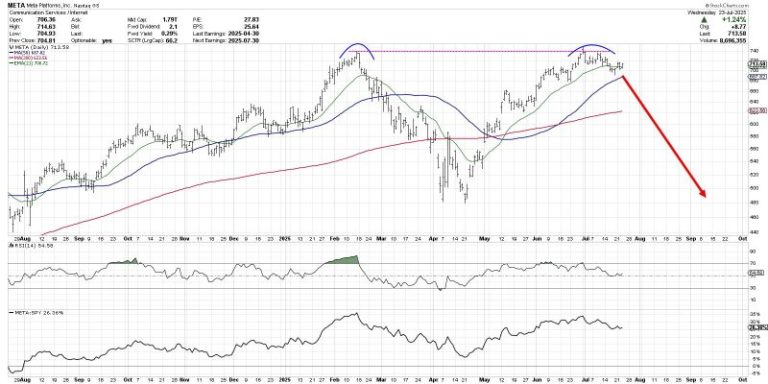
The chart of Meta Platforms, Inc. (META) has completed a roundtrip from the February high around $740 to the April low at $480 and all the way back again.  Over the last couple weeks, META has now pulled back from its retest of all-time highs, leaving investors to wonder what may come next.

Is this the beginning of a new downtrend phase for META?  Or just a brief pullback before a new uptrend phase propels META to new all-time highs?

Today we’ll look at two potential scenarios, including the double top pattern and the cup and handle pattern, and share which technical indicators and approaches could help us determine which path plays out into August.

The double top scenario basically means that the late July retest of the previous all-time high was the end of the recent uptrend phase.  The double top pattern is literally when a major resistance level is set and then retested.  The implication is that a lack of willing buyers means the uptrend is exhausted, and there is nowhere to go but down.

While the 21-day exponential moving average is currently in play for META, I would say that a break below the 50-day moving average could confirm this as the correct scenario.  If that smoothing mechanism does not hold, then the price action would imply less of a pullback and more like the beginning of a real distribution phase.

What is META pulls back but then resumes an uptrend phase, leading META to another new all-time high?  That would result in a confirmed cup and handle pattern, created by a large rounded bottoming pattern followed by a brief pullback.  The key to this pattern is the “rim” of the cup, which sits right at $740 for META.

Given the pullback META has demonstrated so far in July, I would say that a break above the $740 level would basically confirm a bullish cup and handle pattern.  That would suggest much more upside potential for META, as the stock would literally go into previously uncharted territory.

So how can we determine which scenario is more likely to play out?  This is where we need to incorporate more technical indicators into the discussion, as a way to further validate and confirm our investment thesis.

Just to review, I think a break above $740 would confirm a bullish cup and handle pattern.  I would also say that a break below the $680 level, which would represent a move below the 50-day moving average as well as the June swing lows, would basically confirm a bearish double top pattern.

We can also use the Relative Strength Index (RSI) to help determine whether META remains in a bullish trend phase.  During bull phases, the RSI rarely gets below 40, because buyers usually step in to “buy the dips” and keep the momentum fairly constructive.  So if the price would break down, and the RSI would not hold that crucial 40 level, that could mean a bearish outlook is warranted.

Finally, we can use volume-based indicators to assess whether moves in the price are supported by stronger volume readings.  Here I’ve included the Accumulation/Distribution Line, which tracks the trend in daily volume readings over time.  We can see that the high in July resulted in a divergence, as the A/D line was trending lower.  If the A/D line would break below its June and July lows, marked by a dashed red line, that would represent a bearish volume reading for META.

Technical analysis is less about predicting the future, and more about determining the most probable scenarios based on our analysis of trend, momentum, and volume.  I hope this discussion shows how the outlook for META can be easily determined and tracked using the best practices of technical analysis!

RR#6,

Dave

PS- Ready to upgrade your investment process?  Check out my free behavioral investing course!

David Keller, CMT

President and Chief Strategist

Sierra Alpha Research LLC

marketmisbehavior.com

https://www.youtube.com/c/MarketMisbehavior

Disclaimer: This blog is for educational purposes only and should not be construed as financial advice.  The ideas and strategies should never be used without first assessing your own personal and financial situation, or without consulting a financial professional.  

The author does not have a position in mentioned securities at the time of publication.    Any opinions expressed herein are solely those of the author and do not in any way represent the views or opinions of any other person or entity.

Markets don’t usually hit record highs, risk falling into bearish territory, and spring back to new highs within six months. But that’s what happened in 2025.

In this special mid-year recap, Grayson Roze sits down with David Keller, CMT, to show how disciplined routines, price-based signals, and a calm process helped them ride the whipsaw instead of getting tossed by it. You’ll see what really happened under the surface, how investor psychology drove the swings, and the exact StockCharts tools they leaned on to stay objective. 

If you’re focused on protecting capital, generating income, and sleeping well at night while still capturing the upside, this is a must-watch. Discover which charts deserve your attention now, what to ignore, and how to prep for the back half of 2025. 

This video premiered on July 23, 2025. Click on the above image to watch on our dedicated Grayson Roze page on StockCharts TV.

You can view previously recorded videos from Grayson at this link.

Tackling soaring inflation in the US is the job of the country’s central bank, known as the US Federal Reserve, or the Fed.

The US Fed has consistently made headlines in recent years due to its role in managing inflation through the use of interest rate changes.

Between mid-2021 and 2023, the US economy experienced high inflation, peaking at 8.5 percent in July 2022. The Fed has helped bring it largely under control through careful interest rate increases during that time period.

According to US Labor Department data, the inflation rate in July 2025 was 2.7 percent. As this is still above the Fed’s target of 2 percent, the bank has been slow to lower interest rates so far.

It’s important for any investor to understand the ins and outs of the Fed’s role in US monetary policy and interest rates, as its decisions have a strong impact on US and global markets as well as precious metals prices.

In this article

    What is the US Federal Reserve?

    The Federal Reserve, often referred to as the Fed, is the US central bank and monetary authority. It was established by the Federal Reserve Act in 1913, which gave the Fed responsibility for setting monetary policy in response to the 1907 Banker’s Panic.

    “The Panic was caused by a build-up of excessive speculative investment driven by loose monetary policy,” explains Investopedia. “Without a government central bank to fall back on, U.S. financial markets were bailed out from the crisis by personal funds, guarantees, and top financiers and investors, including J.P. Morgan and John D. Rockefeller.”

    Although it is an independent government agency, the Fed is accountable to the public and US Congress. The current Fed Chair is Jerome Powell, an investment banker who served as assistant secretary and undersecretary of the Department of the Treasury under former President George H.W. Bush. Powell took the helm at the Fed in 2018.

    The Fed has a dual mandate: to achieve stable prices and stable employment. The government agency also provides banking services and is the main regulator of the nation’s banks. In times of economic turmoil, the Fed also acts as a lender of last resort.

    It’s important to note that while the Fed manages the national monetary policy and regulates the financial system in the US, its actions also have a powerful influence on the global economy.

    What is the FOMC?

    The Federal Open Market Committee (FOMC) is the Fed’s monetary policy-making body. The 12 members of the FOMC are the seven members of the board of governors of the Federal Reserve System, the president of the Federal Reserve Bank of New York and four of the 11 reserve bank presidents who rotate through the positions for one year terms.

    Why does the US Federal Reserve hike or cut interest rates?

    For more than a century, the Fed has been tasked with keeping a watchful eye on any structural risk to monetary stability in the US financial system, and rising inflation and high unemployment are two of the biggest threats to monetary stability.

    In the face of rising inflation, the Fed raises interest rates in the hopes of reigning in rapidly rising prices by curbing demand. When interest rates are higher, borrowing money becomes more expensive, which ultimately slows consumer spending and curtails corporate growth.

    During times of slow economic growth, the Fed lowers interest rates in order to stimulate the economy. Lower interest rates in effect lower the cost of borrowing and investing for both businesses and individuals.

    The Fed’s goal is to keep inflation around its target rate of 2 percent, and unemployment around 4 to 4.5 percent.

    “The principle of inflation targeting is based on the belief that long-term economic growth is best achieved by maintaining price stability, and price stability is achieved by controlling inflation,” according to Investopedia.

    What are the biggest contributors to US inflation?

    Inflation is calculated through factoring in price changes of a weighted basket of goods and services, as well as housing.

    For example, the COVID-19 pandemic that began in 2020 caused a surge of inflation in the US and globally.

    Prices of goods were driven higher by a mix of factors, including significant supply chain disruptions hurting product availability, and economic stimulus packages increasing spending power and demand.

    Additionally, the lasting switch to work-from-home for many led to increased demand for homes with space for offices, driving up housing prices. As housing is the highest weighted factor when calculating US inflation, this was one of the biggest drivers of inflation in the 2020s.

    Global supply chains have since been hampered by factors like Russia’s ongoing war in Ukraine and growing conflict in the Middle East. There is also the uncertainty generated from the global wave of tariffs sparked by US President Donald Trump’s trade policies, which will raise the cost of goods purchased by American consumers.

    This global supply and demand imbalance has led to rising prices for a wide range of consumer products, from gas to groceries. The result has been a loss in purchasing power for US consumers as their dollar needs to stretch further.

    How much has the US Federal Reserve hiked rates since 2022?

    In an effort to fight inflation, the American central bank consistently increasing rates from its March 2022 meeting with an initial boost of 25 basis points. Its hike of 75 basis points in June 2022 was at the time its largest since 1994, and it was followed by another three hikes of this magnitude in 2022.

    The Fed raised interest rates by 5.25 percentage points between March 2022 and July 2023 before holding at 5.50 percentage points for more than a year. The Fed’s current rate cutting cycle began with a .50 drop in September 2024.

    _FOMC meeting date___

    Rate hike in basis points_

    Target federal funds rate_

    January 25 to 26, 2022

    N/A

    0 to 0.25 percent

    March 15 to 16, 2022

    +25

    0.25 to 0.5 percent

    May 3 to 4, 2022

    +50

    0.75 to 1 percent

    June 14 to 15, 2022

    +75

    1.5 to 1.75 percent

    July 26 to 27, 2022

    +75

    2.25 to 2.5 percent

    September 20 to 21, 2022

    +75

    3.0 to 3.25 percent

    November 1 to 2, 2022

    +75

    3.75 to 4.0 percent

    December 13 to 14, 2022

    +50

    4.25 to 4.5 percent

    January 31 to February 1, 2023

    +25

    4.5 to 4.75 percent

    March 21 to 22, 2023

    +25

    4.75 to 5.0 percent

    May 2 to 3, 2023

    +25

    5.0 to 5.25 percent

    July 25 to 26, 2023

    +25

    5.25 to 5.5 percent

    How many times does the Fed meet each year?

    The FOMC holds eight meetings per year, typically scheduled every seven weeks. According to the Fed’s website, during these meetings the FOMC “reviews economic and financial conditions, determines the appropriate stance of monetary policy, and assesses the risks to its long-run goals of price stability and sustainable economic growth.”

    How many more US Federal Reserve meetings this year?

    As of August 21, three more Fed meetings are scheduled for 2025, and market participants will be closely watching these events.

    It’s too soon to know what exactly the Fed will do at these remaining meetings, but its July statement gives some clues — in it, the central bank said that it ‘seeks to achieve maximum employment and inflation at the rate of 2 percent over the longer run. Uncertainty about the economic outlook remains elevated. The Committee is attentive to the risks to both sides of its dual mandate.’

    At the time, the Federal Reserve decided to hold rates steady at 4.25 to 4.5 percent for the fifth straight meeting as inflation remained elevated and job numbers appeared strong. The decision placed downward pressure on the gold price as a better economic outlook dimmed demand for the safe-haven asset.

    While the current tariff war between the US and many of its major trading partners has some calling for a return to higher inflation, weak unemployment figures and other economic data published since the last meeting has caused others to consider the potential for a recession before the end of the year.

    ‘At present, the latest economic data have been sufficiently mixed as to support either policy alternative,’ according to analysts writing for the Peterson Institute for International Economics. ‘The case for a rate cut is driven by the pronounced slowing in job creation, the failure of inflation to respond much to the initial tariff increases, and the fact that most FOMC participants view the current stance of policy as slightly tighter than neutral.’

    Securities Disclosure: I, Melissa Pistilli, hold no direct investment interest in any company mentioned in this article.

    This post appeared first on investingnews.com